
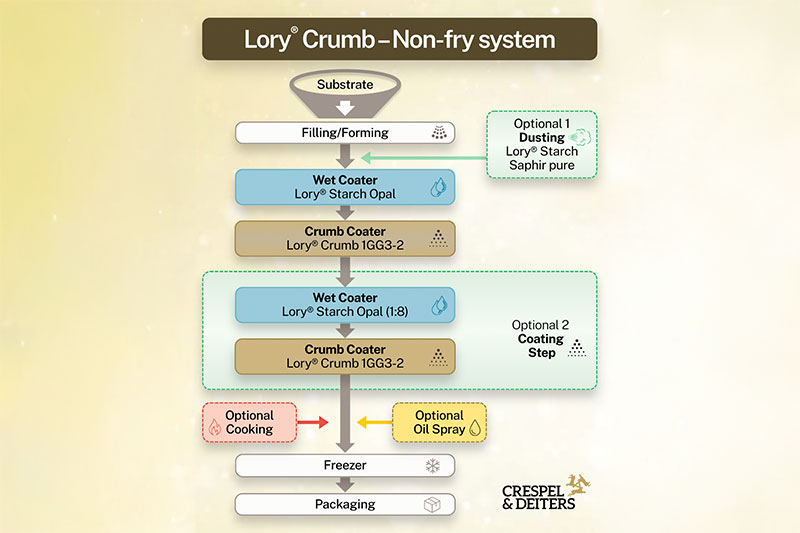
Despite their popularity, fried snacks and convenience products are facing growing pressure in terms of consumer taste expectations, nutritional content and sustainability. With Lory Crumb Non Fry, Crespel & Deiters Food presents an innovative breading system that delivers a crisp texture and golden-brown appearance without the need for frying. The result: Cost- and energy-efficient processes, and end products with an improved nutritional profile that perfectly meet the needs of manufacturers looking to address evolving market requirements.
As demand for reduced-fat, nutritionally optimised foods continues to grow, topics such as Nutri Score, calorie reduction and resource-efficient production are shaping innovation agendas across R&D and marketing. At the same time, consumers continue to expect superior sensory properties. The good news is that all these challenges are perfectly addressed by Lory Crumb Non Fry system.
This innovative solution is based on extruded crumbs designed to create a uniform surface and consistently crisp texture. Furthermore, balanced particle size distribution creates an attractive, highly stable, golden-brown appearance, with the formulation designed to work with colouring foodstuffs rather than artificial colours.
Optimal adhesion without the need for frying is provided by Lory Starch Opal, a specially developed wheat starch used as a batter. It ensures excellent adhesion of the crumbs and supports optimal crispness. Its cold-swelling properties also enable stable batter systems without additional ingredients. Depending on the application, further process steps such as dusting, for example with Lory Starch Saphire Pure, or multi-stage breading can be integrated.

The decisive advantage, however, lies in the process: eliminating the frying step removes energy intensive production stages. This reduces capital and maintenance costs, avoids production bottlenecks and significantly lowers oil consumption. Reduced raw material input, less waste and an optimised CO₂ footprint improve both economic efficiency and sustainability. In addition, the reduction in fat allows for a potentially improved Nutri Score of the end product.
The system also performs well in food service, where products can be prepared in combi steamers, ovens or air fryers, remaining crispy and visually appealing even under heat-holding conditions. End consumers benefit from clean, convenient preparation without a deep fryer, residual oil or any loss of quality.


