
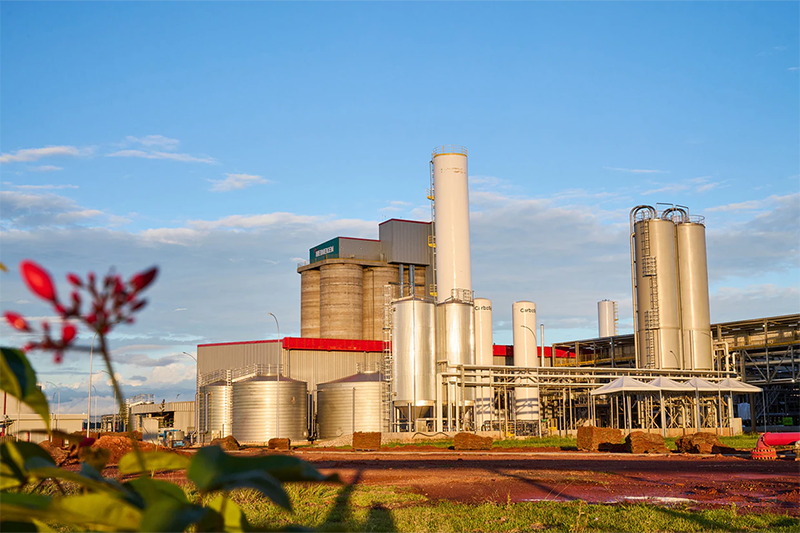
The choice of Passos as the location for the new brewery was the result of a meticulous selection process, as the brewery’s director Reinaldo Franco explains: “We had three decisive factors: good access to road and rail routes, the availability of top-quality water, and a well-trained workforce. We found all of these in Passos, plus good relations with the local authorities. So far everything has worked perfectly, the new brewery is a genuine win-win arrangement.”
The production site in Passos supplies the Brazilian beer market’s premium segment with Heineken and Amstel beers, both pure-malt brands brewed in line with the company’s own purity law. Only malt, water, hops and yeast may be used for making them, nothing else. In its current stage of completion, the facility boasts an annual production output of five million hectolitres of beer, with ample space for expansion.
The brewery operates entirely on renewable energy: Hydro-electric power and photo-voltaic systems are used to generate electricity, and biomass boilers produce the thermal energy needed. Water consumption was once again substantially reduced to an amount even lower than in the already stringent Heineken standards. Part of the beer output is filled into returnable glass bottles. Heineken’s sustainability strategy also includes social and environmental projects in the region, plus of course jobs. The brewery has created around 350 new jobs, with 60 per cent of these given to local residents.
Sustainability is a top priority
Throughout the sector, Heineken is well-known for its ambitious sustainability goals. For example, the group intends to achieve net-zero emissions along the entire value chain by 2040, and for Scope 1 and 2 emissions by as early as 2030. Minimised water consumption, the preservation or restoration of local water catchment areas and the maximum use of material cycles are further pillars of Heineken’s sustainability strategy. The group’s goal is to ensure that by 2030, 43 per cent of the products sold worldwide are packed into re-usable containers and only bottles and cans with a minimum recycled content of 50 per cent are used.
Filling technology made by Krones
Krones supplied all the filling equipment for the new facility, four lines in all: one for cans, two for 0.33-liter non-returnable longneck glass bottles and one for 0.66-liter returnable glass bottles. More than 400 containers were needed to ship the machines to Brazil and then onward to Passos by truck. “You can’t imagine the commotion when the four lines arrived here in an endless series of trucks and containers. You see, Passos isn’t really that big, so people were very curious,” recalls the brewery’s director Reinaldo Franco.
Why was Krones awarded the contract? Reinaldo Franco gives three reasons: cost advantage, technology and a mutually supportive relationship. “Krones and Heineken in Brazil can look back on many years of fruitful cooperation. We knew that we’d always be able to rely on Krones and in a big project like this you definitely need a strong partnership. Krones met all our requirements for the technical equipment and their price was spot-on as well.”
Brazil: a beer powerhouse
With an annual output of roughly 150 million hectolitres, Brazil is the world’s third-largest beer producer, behind China and the USA. Heineken began establishing a strong presence in this country in 2011. The company currently has 13,000 employees on its payroll, and 15 breweries up and running.


