
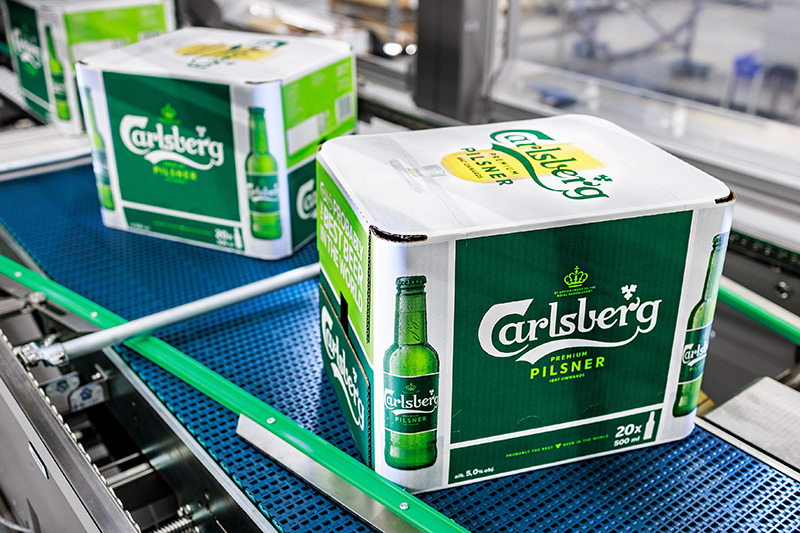
In a show of joint force, a real packaging innovation has now been created: together with DS Smith and KHS and based on SCA's patented Arcwise technology, Carlsberg is launching an eye-catching premium multipack with rounded corners to market, starting with Poland. Further projects are in the pipeline.
When Carlsberg starts contemplating innovative new packaging designs, the focus is on the consumer. Packaging Innovation Director Marine Andre gets straight to the point. "For us, consumer experience has top priority. After all, in store we have less than two seconds for our products to be noticed on the shelf. If you're not conspicuous, you're not there." This is hardly surprising when we consider that one consumer passes about 300 different products a minute at the supermarket.
Intensive market research has discovered that sustainability is something consumers expect - but don't actively 'reward'. They're not willing to pay a premium for it. It's thus all the more important that sustainable packaging is both functional and gets brands noticed. "We're consciously trying to break down the barriers between sustainable packaging, optimised costs and the perfect consumer experience," explains Andre. "If a system doesn't score with at least two of these criteria, it's doomed to fail."
Visual brand presence
One good example that shows how Carlsberg is exploring new avenues is the DS Smith Round Wrap, a cardboard multipack with curved edges for beer bottles. It provides added value on three counts. Firstly, it gives the brand a greater visual presence, upgrades the pack and boosts its impact on the shelf. This has been proved by scientific studies carried out by Harvard Medical School, among others: they show that objects with round shapes are perceived as being more attractive than those with square corners and edges. Secondly, this new style of secondary packaging uses less material, has a smaller carbon footprint and is better protected against damage during transportation. And thirdly, as the pack can be produced on existing packaging machines, no large investments are needed, with the consumer not having to pay a higher price.
77% of those surveyed would be more willing to purchase a product with the improved rounded wrap-around design than another type of packaging
Testing material combinations
Rounded corners make high demands of the material and the way it's processed. Jonathan Carter, Head of Innovation Product Management at DS Smith, explains what's important here.
"We need an outer liner that's robust enough to stabilise the curve, whereas the inner liner must be much lighter to enable the fluting to form perfectly. This is the only way to produce a smooth curve without the material creasing or tearing."
To make sure the quality was right, DS Smith tested countless combinations of paper, types of corrugation, adhesive and machine parameters in a labour-intensive, iterative process before the material was dispatched to the customer. Carter is pleased to call the test result the "golden ratio" of material composition.
Resounding success
The finished secondary packaging is being well received by retailers and consumers. On the one hand, the rounded corners are less susceptible to damage during transportation, in the warehouse and at the POS. On the other, the curved design already appears to be enhancing sales, even if no concrete figures are yet available.
This is confirmed by a consumer study commissioned by DS Smith which shows that an average 77% of those surveyed would be more willing to purchase a product with the improved rounded wrap-around design than another type of packaging. This could lie in the fact that the rounded corners provide additional space for brand communication, for instance. What's more, the box lid printed with its advertising motif can be opened and propped up in a vertical position for sale of single bottles - just like a miniature display.
Proven sustainability
Besides on design and function, the new premium pack scores further points for its ecological footprint. Thanks to the lighter inner liner and optimised blank, up to 20% less material is required.
"Depending on the basis for comparison, we use up to about 24% fewer CO2e," smiles Jonathan Carter. Here, Carlsberg in Poland reckons on saving approximately 224 metric tonnes per year. Additional positive effects are generated in conjunction with logistics, such as greater pallet stability and lower consumption of stretch film.
Launch to further markets
The DS Smith Round Wrap is now fully developed and ready for use on further markets. Carter believes the conditions for this are good.
"We've already successfully tested production in numerous key locations across EMEA" [eds: Europe, the Middle East and Africa]. "We have the know-how; now we need to scale this up together."
Carlsberg holds similar views. Here, they trust in subsidiary demand and aim to roll out the new format selectively. Where market volume, brand strategy, material supply and machine technology all slot in with one another, there's nothing stopping a wider launch, states Carlsberg headquarters.


